
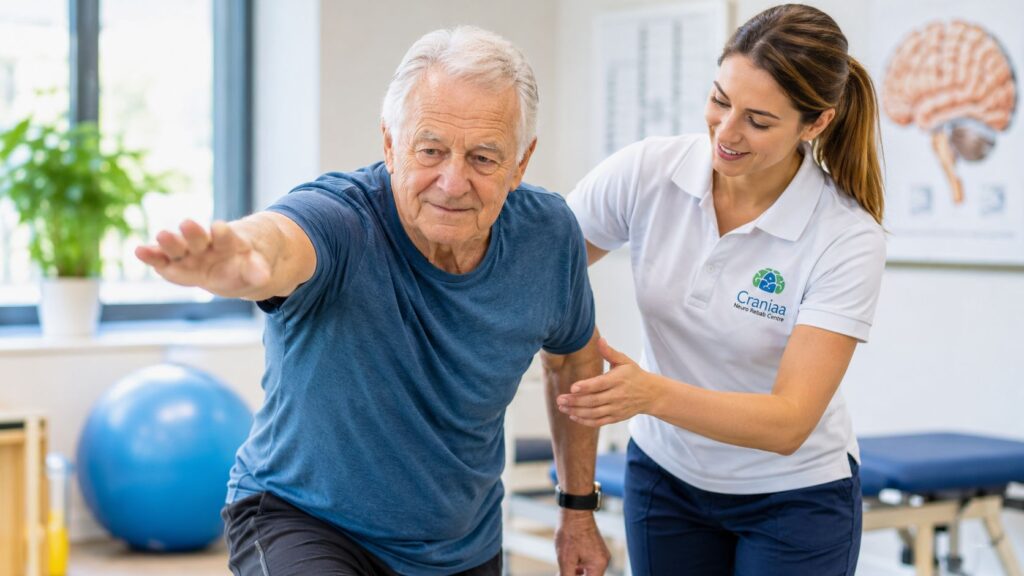
Parkinson’s patients find that even basic daily tasks become progressively harder to accomplish. Simple actions such as walking, standing up from a chair, turning, and balancing may need more energy. In time, such issues can have an impact on confidence, mobility, and independence. Fortunately, the right help through rehabilitation can make all the difference. Neurophysiotherapy for Parkinson’s is designed to improve movement and physical problems while enabling patients to stay active.
Understanding Physiotherapy for Parkinson’s Disease
Parkinson’s disease is a progressive disorder affecting the brain’s capacity to control movements. The disease causes low levels of dopamine production and can lead to symptoms like trembling, muscle stiffness, slowed movements, coordination problems and changes in gait.
Physiotherapy for Parkinson’s disease plays an important role in managing these physical challenges. Rather than following a general exercise routine, treatment focuses on an individual’s symptoms, physical abilities and daily activities.
Early assessments will help in identifying problems with movement and setting out rehabilitation objectives. The focus at Craniaa Neuro Rehab Centre is to understand the needs of each individual and assist them in achieving functional movement.
How Parkinson’s Physiotherapy Supports Daily Activities
Parkinson’s physiotherapy aims to help individuals maintain physical function, improve movement control and manage difficulties that affect everyday life. A tailored programme may include strength training, flexibility exercises, posture correction, coordination activities and functional movement practice.
Personalised Parkinson’s Rehabilitation
Effective Parkinson’s rehabilitation begins with an individual assessment. The physiotherapist will consider aspects such as the patient’s ability to walk, muscle strength, posture, balance, flexibility, and other limitations when planning the course of treatment.
This ensures that therapy for Parkinson’s disease will help in achieving practical goals, such as standing without assistance and moving around the house. Treatment can be reassessed and modified accordingly.
Exercise for Parkinson’s Disease: Improving Physical Function
Regular, appropriately supervised physical activity is an important part of managing Parkinson’s disease. Suitable Parkinson’s disease exercises can support strength, mobility, endurance, coordination and general physical wellbeing.
Balance Exercises for Parkinson’s
Poor balance can make one susceptible to falling and decrease one’s confidence while moving around. Some of the balance exercises for Parkinson’s disease may include weight shifting, standing with support, stepping, and coordination.
The exercises have to be tailored according to the individual’s capacity and fall risk.
Gait Training for Parkinson’s: Building Walking Confidence
The various alterations in gait include smaller steps, less movement of the arms, shuffling, and freezing, which are some of the difficulties experienced by people with Parkinson’s disease.
Gait training for Parkinson’s is mainly aimed at enhancing gait by practicing step-length, rhythm or visual prompts, turning, and gait coordination.
Parkinson’s Physiotherapy in Ireland: Finding the Right Support
Access to suitable rehabilitation can help people living with Parkinson’s remain active and maintain independence. Parkinson’s physiotherapy in Ireland should be based on individual assessment, appropriate clinical expertise and achievable treatment goals.
In case you are thinking about neurophysiotherapy in Ireland, ensure that you find a physiotherapist who is well experienced in neuro-rehabilitation. In our Craniaa Neuro Rehab Centre, we emphasise personalised neurorehabilitation for people having neurological movement problems.
Take the Next Step Towards Better Movement
Parkinson’s disease is unique to everyone, but there are ways that rehabilitation therapy can help you deal with movement problems.
At Craniaa Neuro Rehab Centre, we appreciate the need for individualised neurological rehabilitation. Get in touch with us to find out how we can help with your physiotherapy needs.
Take the first step towards more confident movement with professional neurorehabilitation support.
Frequently Asked Questions
Yes. It is through physiotherapy that one can manage problems relating to movement difficulties, balance, strength, and mobility, making the patients confident and independent.
Neurophysiotherapy can be started immediately after the diagnosis of Parkinson’s. An early assessment of the patient enables one to recognise movement difficulties and develop an appropriate exercise regimen for Parkinson’s disease.
Beneficial exercises may include walking, balance training, strength exercises, stretching and coordination activities. A physiotherapist can tailor activities according to individual abilities and safety.
Yes. Gait training, movement strategies and rhythmic cues can help address shorter steps, shuffling and walking difficulties while supporting safer, more confident mobility.
Frequency depends on symptoms, physical ability and rehabilitation goals. A qualified physiotherapist can recommend an appropriate schedule and adjust treatment according to progress.